Showing posts with label Professional Development. Show all posts

Wednesday, December 16, 2009

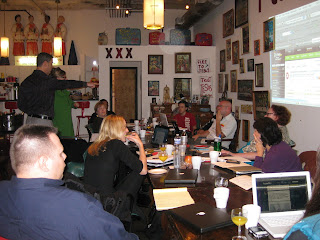
Atlanta Blogging Workshop Review


According to social media expert Erik Qualman, more than 200,000,000 blogs exist. Now, I love my little blog, but it has mostly been written with topics that were of interest to me and a select group of people (“Hi Mom and Dad!”). It’s past time to take my blog to the next level and highlight my copywriting capabilities.

So when I found Hollis Gillespie and Mike Alvear’s Atlanta Blogging Workshop advertised in Creative Loafing, I was ecstatic. Usually I wince every time I shell out more than $25 on myself, but ongoing education is so important. Especially for solo-preneurs like myself where my company’s greatest asset is…me (gulp).

The six hour seminar surpassed my expectations. Although I suspect many of the participants left the workshop with information overload and a long to-do list, I walked out with a clear direction of where to take my blog and what to do next.

Hollis and Mike co-taught, facilitating the exchange of ideas and sharing success stories. They held the class in a cozy, adorable, crazy studio decked out in outlandish décor. Although “finger food and champagne,” was advertised, there was enough food to feed the snackiest of snackers like myself. Delectables came at us all day in the form of fruit, muffins, cookies, cake, pesto pizza, chips, and more. I certainly think better when I’m served mimosas in the afternoon and dining on scrumptious food. The 13 or so of us participants sat in comfy chairs clustered around a long conference table.

Without giving all the seminar content away, I’d like to share a few workshop highlights. It was comprised of the following components:

-we reviewed several sample blogs as case studies to identify success factors
-we went around the room and each participant was able to explain where he or she was with their blog and any challenges they were having. ¾ of the room only had concepts of what they wanted to accomplish and had not created a blog yet. It was great to provide ideas and suggestions to people and in return get feedback for my own blog
-we were taught core blogging concepts such as having a narrow, niche concept, promoting your own work, having passion for your work, and the importance of writing killer content

And lastly, Hollis said something that resonated with me. One of the participants didn’t know what topic he would blog about and was a little lost trying to come up with ideas. So Hollis asked him: what would the world be missing without you in it? Blog or not, we should all consider the answer to this question. Life is about living with purpose and passion. Cheers!

Monday, December 14, 2009

Put Your SEO on Steroids with Blogs


I love webinars and encourage everyone to sign up for webinars with interesting topics. It’s a great way to continue your ongoing education and keep on top of trends (which is very difficult to do sometimes!). Even if you can’t make the webinar at the scheduled time, the host usually sends out a link afterwards so you can listen at your convenience. One of the webinars I “attended” recently was “Put Your SEO on Steroids with Blogs.” I wanted to share some important takeaways from the perspective of focusing on the content, which is what I do as a copywriter. Plus, I am a HUGE advocate for businesses using blogging as a marketing tool and a way to communicate with potential and current clients.

My Webinar Notes:

-blog traffic spikes in the morning and at lunchtime: people like to check blogs first thing while drinking their coffee or right around noon to take break
-make other bloggers a key target for readership
-the user is looking for the answer; that is what you need to center your posts around
-organize content around keywords. My note: don’t make your posts sound ridiculous. If readers can tell what your keywords are, you are doing this incorrectly
-make a list of your top keywords. Think what TERMS drive your business
-what is the language of the customer? Use these words in your copy
-again, think about what people are going to type, and talk about that
-nobody wants LONG thought leadership posts. They want 1) the quick answer to their problem and
2) multimedia
-people skim content online; they want credibility, so give something of value
-to get higher in search, create more content
-a great blog post idea: tell the stories of your company: what problems have you seen? How does your product solve a problem?
-the key getting links (important in SEO) is to write good content
-the TITLE of the blog should be based on keywords as well

For non-techies, SEO is a difficult concept to wrap your brain around. It is certainly very trendy right now, and the amount of information on the web is overwhelming and at times, contradictory. This webinar was worth the hour it took to review the information .That takes a lot for me to say, as I am very protective about my time! Tip: if you attend the webinar from a download after the “live” event, what I think is fabulous is the ability to speed ahead or go back using the fast forward and rewind buttons. Note – I am not affiliated with this webinar. Just a fan!

Tuesday, December 1, 2009

2-Minute Video Book Review: Business Writing - What Works, What Won't


I hope you enjoy my third video review! I really enjoyed this book, Business Writing: What Works, What Won't. Highly recommended if you want to polish your writing skills, learn quicker writing techniques, and get an excellent grammar refresher.


Thursday, November 19, 2009

The Must-Read Books For Women Entrepreneurs


I recently had a chance to participate on a very popular website by sharing my favorite book for women entrepreneurs. It was so hard to pick just one book; I’ve read so many and refer them to people who are in different stages and processes in their career. As I was forced to narrow it down though, I chose one that I still think about often and has really made an impact on me. The site, Toilet Paper Entrepreneur, just went live and is already ranked on Google’s first page - very exciting! Check out the tip from #92 - she seems very smart. :) "The Must-Read Books for Women Entrepreneurs" is brought to you by Toilet Paper Entrepreneurs (great blog for small business owners).

Meanwhile, this picture of the stacked books represents the pile on my kitchen table that I need to get through. Ugh, how do you squeeze more time out of the day?

Saturday, November 14, 2009

Trends in Sales, Web Marketing, and Business Development


Last Thursday I attended B2B Marketing University in Atlanta that was sponsored by Silverpop. It was an interesting concept – invite your target audience to an educational seminar in which there are NO product pitches whatsoever (having it at a top-notch hotel and feeding attendees doesn’t hurt either). Genius. Certainly companies and backgrounds were mentioned but it seemed done more so from the standpoint of establishing credentials.

Over the course of three hours I took five pages of notes, front and back, which I’ll be sharing on this blog. Although I’m no longer in B2B Marketing, it was important for me to be there to learn what the “big boys” are talking about and see how this translates to Small/Medium Businesses (SMB). It is ESSENTIAL in this day and age to stay updated on trends that affect a business owner’s market. One of the speakers even uttered my mantra: “change is the only constant.” Companies that resist change and evolving are going to quickly get left behind.

A few themes developed for me as I was reviewing my notes, and instead of writing one gi-normous post I’ll write a future post on “Tips and Information for SMB." So below are a few of the trends that everyone should become familiar with, according to Silverpop and its comrades:


• The buyer is changing – companies/freelancers are shortlisted before they’re ever called
• Social media is critical to making buyer decisions. So why should a business owner have a blog, submit articles to content-sharing sites, have a Twitter account? Because if he/she doesn’t and their competitor does, it’s an easy decision for the buyer.
• If you can’t be “found” easily, it sends up red flags. When I google a company and can’t find it, it screams out “sketchy” to me.
• There is a fundamental shift focusing on raw leads to managing buyer dialogue to nurture sales-ready relationships
• A trendy new term is “inbound marketing.” Inbound is the ability to 1) Get found and 2) shape community dialogue (this is done via a blog, social media site, etc)
o A fictional example, but one that people can identify with is Dunder Mifflin’s failed “Infinity 2.0” social media project from the popular TV show The Office
• Static websites are dead; websites need fresh, relevant information for SEO purposes. What does this mean for people who have to continuously pay webmasters to update? I don’t know. But for those who don’t have sites yet, keep that in mind.
• Trending words are “manage,” “manage,” and “manage.” Manage the process. Again, back to entrepreneurship 101 of having a proactive not reactive business model.
• Change is the only constant. Get onboard and stop resisting/whining. I tell my husband this all the time as he hates FaceBook, LinkedIn, etc.
• More ROI pressure is being put on vendors. Example: I gave you a $1, now how much is your service giving back?
• Marketers have to adapt, but it is not completely out with the old, in with the new
• Buyers want relationships
o I disagree. I think the word ‘relationships’ is getting old, fast. Buyers want a company with personality. They don’t want you to be their best friend and you shouldn’t like that. But you should stand for something, know how to communicate that, and show up (meaning, be found). • Trend: do to your customers what you’re doing to them. If they mention you on twitter, you do the same. If they comment on your blog, you do the same. Mirror
• Lastly and very important, the difference between “Email Marketing” and “Marketing Automation:”
-EMAIL MARKETING: is more B2C
-MARKETING AUTOMATION: B2B or Complex sales process

Friday, November 13, 2009

eWomen Network Event with Robyn Spizman: Is Your Business Gifted?


Last night I attended the eWomen Atlanta Network meeting at the Ravinia Club. I attended for two reasons: because I have always been curious about this organization and to hear Robyn Spizman give a presentation on “Is Your Business Gifted?” The overall event exceeded my expectations. I have spent the last seven years in sales (which means I’ve been to hundreds of networking events) and can maybe count on one hand the number of events in which members walk up to you proactively to greet you and walk you around to meet other people. It was a very friendly, engaging group.

My notes from Robyn’s speech are below, but first I wanted to highlight the non-verbal features of her presentation which were equally impressive as her message. And I’m not saying this just because I work for her at The Spizman Agency.

Here are a few things worth mentioning:
-Robyn’s words were so effective in part because of her presence. She used NO notes or teleprompters and walked around the entire time.
-she was present; meaning, in her presentation she wove in names, situations, and stories from people she interacted with that very night. This resulted in a very engaged audience.
-we left the event with actionable takeaways. That’s the difference between a good speech and a great speech.
-Robyn elicited a lot of emotion in the audience through her storytelling. It was excellent.

And now, to share a few highlights from the presentation:
-before launching into her content, Robyn promised to increase our business platform and help us find out what our gifts are. This is using the inverted pyramid approach that I use in copywriting – “tell ‘em what you’re going to tell ‘em.” People’s attention spans have evolved and you have to capture their attention and know what they’re getting out of something from the beginning.
-she began with such a simple, yet powerful (and underutilized) practice: learn people’s names and use them which she broke down into simple steps:
1) Learn someone’s name
2) then practice
3) then rhyme it
-know that tomorrow is a gift
-examples of personal gifts can be as simple as the ability to say hello and make friends to the ability to make the best chocolate chip cookies
-people need to concentrate on “budget conscious gifts that reflect our ability to sustain them”
-how does your business serve someone? That’s your benefit.
-leave a message of goodwill; do something out of the box that says “I love you.”
-business building words: How May I Help You?
-people have to communicate and show up
-show up by giving
-Robyn’s gift is her enthusiasm
-in your life, where do you involve what you love? Start there
-you don’t always know what to give, but study the person, study the business
-tell a story, don’t sell a service
-you only succeed if you find out what someone values; ex. Give their PET a gift if they are a petlover
-play with words – ex. “you’re the smartest cookie I know” and give cookies or Starbucks gift card saying “I love you a latte”
-wake up your words, your business
-you’re not selling a product but building a relationship
-when we give, people see us as a leader
-you have to love your service; otherwise you’re doing the wrong thing
-give before you get
-finally, don’t be shy; know how people can help you and communicate that

Thursday, November 5, 2009

Business Communications - Copyediting, Copywriting, and Proofreading: A girl's dream work!


I recently took a Copy Editing and Proofreading class with Jack Smith of The Smith Group. It was a day-long class through Evenings at Emory and I highly recommend the program. Jack specializes in working with nonprofits and focuses on grant writing. We spent the morning talking about the business side of writing/freelancing and the afternoon focusing on the meat of copyediting/copywriting.

The class was 99% women, very Type-A who love pointing out grammar mistakes other people make and who each had an opinion in a highly-charged conversation about whether or not the serial comma should be used. Yes...it was that type of group.

I furiously took notes all day and for those interested, have compiled some useful trends, information, and tips about copywriting, copyediting and proofreading.

-Many people incorrectly and interchangeably use the words copyediting and proofreading. The real definitions are that copyediting means to compile existing/already written material. It is the content and organization of material to cohesion. Proofreading is the final check before launching.
-Content and organization is the meat of copyediting.
-know your grammar weaknesses. Mine are trying to put together words that should not be compound words, such as pot luck, grant writing, table coth, etc. My natural inclination is to make all those words one word. I also always go back and check my subject/very agreements.
-When working on a project for a client, it is extremely important to know what they’re looking for before you begin. That means making sure the client explains exactly what result they want achieved so you both aren’t working on a gazillion drafts.
-It’s also important to know how many pages you can copyedit in one hour. Copyediting is a very tedious task and it’s important to schedule breaks, so factor that in.
-The business has evolved. Gone are the days when copywriting used to mean coming up with advertisements in the paper and copywriters worked on staff. Now the work is more contractual and a large portion of it is online vs in print.
-this doesn’t have much to do with copywriting, but Jack stated (and I wholeheartedly agree), that the opportunities for an employee to stay with the same organization for 30 years are gone. Organizations have evolved, and people need to do the same to stay marketable. As an employee, have a proactive plan, strategy, and purpose. If you are freelancer, multiply this times ten.
-when freelancing, understand your niche and how you fit in. What is your USP? What differentiates you?
-trends that are important to know: the prevalent use of bullet points, italics, and bold to categorize text. NEVER underline a word online unless it is hypertext.
-trends in formatting: one space after the period, not two, and we’re not indenting paragraphs anymore but flush left and ragged right. Double space between paragraphs.
-it’s also interesting to pick up on small nuances and make sure you’re adapting to the language of your clients. For example, if you’re still putting a hypen between “non” and “profit,” that’s the sign of an amateur. The trend is to spell it without the hypen (nonprofit). Small things like that will differentiate you from your competition and show the client you fit in.
-when beginning to freelance, it’s important to have a robust portfolio. Do this by working pro-bono, bartering, or charging a very low rate and then build up from there.
-these days, it’s important to write in an inverted pyramid structure.

We learned a TON more and I’d be happy to share some of the handouts – just reach out to me!

Tuesday, September 22, 2009

The Atlanta Writers Club September Meeting


This past rainy weekend I went to my first Atlanta Writers Club meeting. I am super excited to have found this community of fellow writers where I can network and advance my writing skills. I love the fact that the meetings are free and you don't need to sign up to attend.

For the September meeting they had acclaimed author of Chicken Soup for the Soul series, Mark Victor Hanson, present to the group. He was very humorous and a good storyteller; however, he basically was there to pimp his $1000 writing bootcamp to get authors published. He did offer a lot of value but I was shocked at how many people were actually signing up for program. This is not the first inspirational speaker to do this - I had the pleasure of seeing , James Ray, co-author of The Secret. He led a great event at a local church and I was very motivated until the very end when he started selling the audience on this workshop they HAD to sign up for that was critical for them to meet their goals and succeed in life. People were literally running up the aisle to sign up as he offered a discount to the first few people to register. I think James and Mark have the same business coach because they employed almost identical tactics to sell their respective workshops. I would love to hear from any of these participants if the experience met his/her expectations. I sincerely hope it did but I have my doubts.

The highlight of my weekend was the next speaker: Kathryn Stockett, break-out author of The Help. She mainly spoke about how she got published, her background, a little about the process of writing her book, and then she very candidly answered audience questions. She was such a breath of fresh air and so authentic. You could tell she was also very humble and still seemed surprised herself at how successful her book is doing. She is definitely an author that I will be following in the future and I wish her nothing but success. I look forward to my next AWC event.

Tuesday, August 18, 2009

Women in Technology Book Club: GenderTalk


I have been attending TAG's WIT (Women in Technology) book club and love it for several reasons:


1) It's on a Sunday from 3-5:00. Great time as weekdays are often hard and this gives my husband a little daddy time alone.
2) We read and discuss business books with topics specifically geared toward women.
3) The women are very insightful, intelligent, and savvy
4) There is a great opportunity for networking
5) ***my favorite reason***We don't actually have to READ the book. Best of all, nobody makes you feel guilty and this frees me from the guilt which is why I have dropped out of other book clubs.

I am always reading several novels and professional development books at one time. Currently, I'm reading Twilight, New Moon, A Lifetime of Riches, Good in a Room, What do I say Next, and listening to a few different audio books including a novel by Atlanta author Iris Johansen and The Power of Full Engagement.


At this past meeting we "read" GenderTalks by Connie Glaser. The book generated some GREAT discussion on communication differences between men and women and I was taken aback to learn that I commit many of these communication crimes. Here are a few of my notes:


-Women need to cut to the chase in all communication with men. It was unanimously agreed that men do not understand hints. Be direct.
-Stop apologizing. I say "sorry" all the time. Especially around my male boss.
-De-sensitize yourself
-Don't expect mindreaders. Again, be direct, especially in conversation with your husband, your father, brother, coworkers, boss, waiter, accountant, etc.
-Stick to the facts; it is proven that men's brains cannot register excess verbal chatter.
-men need to keep criticism constructive.
-We need to see the world as WE are, not as it is.
-Communicate from where others are, not where you are
-Stop interrupting with apologies.
-Have a sense of humor. It is another proven study that women cannot tell jokes. If a man tells a joke around you it means he accepts you. Same with cussing.
-Women use more qualifiers. Stop qualifying, saying "I think" and "well maybe." Be confident.
-In emails, use bullet points and 10-20 words. Brief emails.
-Be direct, don't explain.
-One of the women had a great tip - instead of apologizing for something that is not your fault or as a conversation filler, say "That's unfortunate."
-Women need to be better self promoters.
-Speak about what you do well.

I look forward to our book and discussion next month!


TSEA Event: Steps for Building Consensus and Enhancing the Value of Your Event Program

Today I had the pleasure of attending a TSEA (The Association for Exhibit and Event Professionals) event for the first time. I mostly applied because I was interested in the presentation which was going to be on "Steps for Building Consensus: Enhancing the Value of Your Event Program" given by Keith Reznick of Creative Training Solutions. As a side benefit I also sat with some really nice people. Although the presentation was tailored toward corporate exhibit managers it could also apply to sales. Here are a few of my takeaways:

-What are your clients objectives? Build value with your customers. "It ain't about you, it's about them."
-There is a gap between where your clients ARE and where they WANT to be. This gap is where you can provide value.
-what is your client/prospect trying to improve and why?
-Buy-In vs Consensus. Buy-in is where the decision has been made and you then ask for support on your decision. Example, "I need this of you." Consensus is a collaborative effort where the solution is decided upon together.
-understand your customer's perspective, goals. Help the stakeholder accomplish these.
-What's in it for them VS what's in it for me
-Always focus on the solution, not the problem.
-A golden rule in sales: Find out about them before you tell them about you.

Tuesday, August 11, 2009

How to Tell Your Story

Last week I had the pleasure of hearing Mike Wittenstein, CEO of Storyminers give a presentation on How to Tell Your Story. He specializes in helping businesses define and amplify how their customers see them but this can apply to individuals as well. Here are my notes from the program:

Expressing Yourself:
-identify, control, amplify. What is your vibe you put out?
-You can’t tell others your story; they will create from their perspective
-It is important that you be different. Different means preferred, better for your audience. Your story starts with how you’re different
3 steps:
1. Ask for testimonials - in an email, on LinkedIn, recommendations, etc.
-People will tell us who we are in their eyes. What themes continually pop up? Capture “turns of phrase” and understand the words they use. Learn to see yourself as others do
-use that to say “some of my clients say that I am ___." Or “one of my past colleagues said that I am __.”
-get 2 dozen testimonials
2. Create a Reason for Being
-this is your North Star, why you wake up. Where is your focus, passion?
a)WHO do you serve? Characterization of target audience. Who is your customer? State in their words
b) what OUTCOME do you deliver? What does someone value? Ex, what activity
c) HOW do you do it?
Mike's example: I help people in business. I help them tell their most important story. I capture patterns/experiences that connect them to their audience.
3. Record a friendly interview (not a Matt Lauer interview)
Ask amazing questions. Ex. Who is your hero? What are your ideas, values? What’s your reason for being? What motivates you, makes you tick? When to follow vs when to lead? Lead up to focus, help them focus their strengths. Take the tape recorder and turn it around. See what/how they tell their story. How do they interpret your story? Practice over and over. Fresh feedback.

Final Notes:
-think about "What does the work I do look like?" Create an experience that other person discovers is uniquely you. Read between the lines; what do you remember most? Plant nuances. What would you tell another person about me/him/her?
-Control: Is not possible. Own your presence, profile. Be consistent everywhere. Check yourself out.
-Amplify: share your story. Be consistent and be everywhere (Bio, Resume, twitter, blog, website, mktg plan, etc). Work your passions and discipline. Find yourself and share info properly. Create your own sales team. 10 tell 10. Loose connections and connectors (Malcolm Gladwell)
-Don’t stick your head in the sand. What floats your boat, makes you DIFFERENT and BETTER.

Go through these exercises, discover this, and you are on your way.

Tuesday, July 28, 2009

Networking vs Working the Room

I have been thinking a lot lately about Networking. I have been attending networking events, have gone to events specifically on Networking education, and am reading a few books right now on the subject. It finally dawned on me that Networking is extremely different than Working the Room. Yes, it took all that but I finally get it.

I went into my quest for knowledge on networking specifically looking for information on how to approach and build rapport with strangers. I have always been shy to walk into a room full of people already grouped together in discussion when I know no one. But after some introspection this perceived idfficulty I now have the confidence to hold my head up when walking into a room and engaging with a person standing by himself or can walk up to a group and join their conversation (which is more difficult). However, I didn’t realize that the follow-up and relationship building is the more important part of networking. And that you can’t just follow up once, you have to put it on your calendar to follow up again and establish yourself as a resource based on a rapport-building topic or something you have in common. And that has been harder for me – to uncover something in an initial conversation that gives me a good reason to follow up and be a true resource, friend, partner, supplier, etc. Does anyone have any good books on that topic?

Wednesday, July 8, 2009

My Initial Twitter Experience

I REALLY didn’t want to begin twittering and have resisted for a long time. I am already feeling the time-suck of social media by writing two different blogs based on two completely different interests, trying to beef up my LinkedIn account and navigate all its capabilities, maintaining a personal FaceBook page where I post pics of my baby, and helping my company utilize our corporate Delicious and FaceBook pages.

I decided to start VERY slowly with Twitter. I created an account and then sat on it for days. Then I gradually searched and followed experts and thought leaders to see what they were doing. I have changed my profile about 10 times and will probably keep changing it until I decide what my objective and strategy is for Twitter so that when I finally narrow my focus I will already be up and running. Three of my observations:

-I am not tweeting with my best friends and I don’t necessarily want to. I am on Twitter to follow the experts in a field and soon hope to establish my own niche and develop an expertise. This is not my FaceBook account and the two audiences are very different.
-Again, it’s not so much the tool. Twitter is just another medium in which experts get their message across.
-I really like that I can access Twitter from my BlackBerry. While the application is a little slow, it gets the job done.
-Writing a compelling message in 140 characters is actually pretty difficult

Social media will dominate you and your time unless you proactively take control, know your purpose and objectives, and set aside time in your schedule. Most importantly ABIDE by that time. If you have a Twitter account, follow me here: @jennymunn

Tuesday, June 30, 2009

Networking Bootcamp - AWRT Event

This morning I attended a very educational event, Networking Bootcamp, put on by the Atlanta Chapter of American Women in Radio and Television (AWRT). The speaker was Debbie Rodkin, Executive Director of re:FOCUS on Careers.

Two interesting things: 1) although I was the only person NOT affiliated in any way with AWRT, they had opened it to the public which I thought was great. Next month they are featuring a meeting on “Reverse Mentoring,” which is where the younger people mentor the older people in technology and social media. What a great idea and I’d love to attend that meeting for the sole purpose of gauging its effectiveness and attendee reactions. 2) The speaker, Debbie, has a full-tie job in addition to her Executive Director job at re:FOCUS. I asked how she managed her time effectively and she said that she averages about four hours of sleep per night. WOW.

Here are some notes I took from this morning:

-show up early, act as a host and greet others coming in. Use the time to mentally prepare what you want to get out of the meeting.
-what is the purpose for being there? For every event you should know why you’re there, who you want to meet, etc.
-small talk: use this to influence the conversation; make it about the other person and have questions ready. A GREAT question to ask in the course of a conversation is “what would be a good referral for you?” I have been asked this a few times recently and it really takes the conversation to the next level and reflects very well on the person asking.
-make conversation about the other person, but talk about topics that interest you too.
-do not be afraid to go up to a group of people who are already in conversation. This is intimidating but can produce great, unexpected results.
-know when to disengage and move along in a polite manner
-having an elevator pitch is extremely important; people cannot help you unless you can clearly communicate what you do
-don’t leave the follow-up to others; be proactive and touch base as soon as possible before life and work get in the way. **** This is a crucial, much-overlooked part of networking****
-be in the know and position yourself as a resource.

To sum up, I attend a lot of events around Atlanta and network quite a bit – I highly recommend this seminar and the useful takeaways that can be applied immediately.

Monday, June 15, 2009

Managing Transitions/Company Strategy Meeting


Last Thursday my company held its annual strategy meeting. We brainstormed some great ideas for this year and next and I am looking forward to putting our ideas into actionable steps. Our industry is slowly but surely coming around and there is definitely a light at the end of the tunnel.

One of my favorite parts of the meeting was having Jane Gentry facilitate our meeting. It was a great experience to have a third party motivate, moderate, and direct our strategy sessions and lead us on a few fun exercises. Jane presented to us on a very timely subject - Managing Transitions. It is one of her most sought-after presentations. Here are a few highlights and takeways:

-Many times when a change happens, focus is on the wrong place
-“change” and “transition” are two very different things. Transition is the activity of influence. A change usually means that something will be lost.
-even if a change is positive, people still have to let go of something
-a coach can help a person figure out what they “perceive” they are losing. Perceptions can be very different from reality
-many people get stuck in the “letting go” phase and can be stuck in it for years
-there are 3 main phases when a change occurs: Letting Go, Neutral Zone, and New Beginnings
-to help let go of the old way create a memorial or ritual. Honor and respect the old way to accept the new change
-in a company, high performers are the most at risk because they have the most to lose
-the Neutral Zone provides us an incredible opportunity to get creative and stand out!
-the Neutral zone can be a lonely, uncomfortable place
-Habit inhibits creativity

Much more was discussed but it was very eye opening, as this information is so applicable to life and business. Visually, it helped tremendously to see a picture of the phases and know how to work with people who are in different stages of a transition. I highly recommend reaching out to Jane if you or your company could use some help in this area.


Monday, June 8, 2009

Article: "To Boost Sales, Check Your Optimism Level"

This recession is certainly the optimal time for a company to really think about, strategize, and sell what sets it apart. I enjoyed this article entitled "To Boost Sales, Check Your Optimism Level." Here is a good excerpt:

Optimistic salespeople take control. They know sales is the greatest profession to be in during a recession. They can meet with mentors who can help them look at another way of doing business in tough times. They can outwork their competitors. They can invest in learning and outsmart their competitor. Optimistic salespeople manage results, not excuses.

Good advice these days as we are ALL salespeople, whether it is in our title or not.

Sunday, May 17, 2009

Confidence vs Cockiness

I have always been a “fake it until you make it” kind of person when it comes to confidence. I’ve also always been jealous of those who seem to have been born with the innate talent for being very sure of themselves without crossing the line to cockiness. It’s a fine line for sure.

Right now I’m reading a great book that I randomly picked out at the library called “Lions Don’t Need to Roar: Using the Leadership Power of Professional Presence to Stand Out, Fit In, and Move Ahead.” It’s a very good read that give short bursts of tips and advice without overloading the mind. These are all things we know, but don’t make a conscious effort on in business situations. I’ll share more as I continue with the book but here are some things that apply to me (I think!):

-Give slow, deep, and purposeful nods; don’t nod your head like a bobble-head
-Eye contact is very important when you meet a C-level executive or someone you hope to impress
-maintain eye contact 1 second longer than necessary
-enter a room purposefully as if to say “I know who I am and I know what I’m doing”
-When at a networking event, size up a room, then move directly and deliberately to the person you want to speak with.
-confident people pause; learn to use strategic silences
-hold a handshake a split second longer than necessary
-extend my hand consistently to both men and women in all situations

There’s much more but I’d like to leave you with something that I heard Beyonce say in an interview: she said that she doesn’t feel guilty for everything she has in life and deserves it all because she works harder than anybody she knows. As an example, she gave a run-down of her activities the past 48 hours and whew, she does stay busy. My husband thinks she is very cocky but I think it is admirable that she said that and has the confidence to do so.

Monday, May 4, 2009

LinkedIn and Social Media Tips from David Nour

So I heard a great keynote speaker the other day who is a Social Media/LinkedIn/Networking expert named David Nour. He had some great advice and tips that I wanted to share with ya’ll. I hope you find it useful and please let me know if you have any questions or need clarifications.


LinkedIn:
-less than 10% of people know how to use it (use it for growing a network and for business contacts).
-to search for a target person do an “advanced search.” Example, type in “Current VP at Disney.” The number to the side of the list that pulls up is the degree of separation between your network and theirs.
-advanced search also lets you filter by geography.
-if you are looking for an introduction to someone in your friends’ network, don’t ask for an introduction unless you know your friend very well. Ask “what can you tell me about him/her” and get creative.
-build a content rich profile
-recommend others and get recommendations for yourself
-on your profile promote what you’ve done and what you want to do, projects, etc.
-use bullet points
-join groups specific to your industry and interests. Then contribute relevant information to questions, discussions, forums, and start initiating your own thoughts and questions.


Websites to visit:
-slideshare.net is the YouTube of presentations. Visit slideshare.net/dnour for the speaker’s page.
- http://www.relationshipeconomics.net/RENetworks.html. (This is his social network/community site)
-aNobii is a social media site about books
-American Well is a social media site reinventing healthcare

Other information:
-when utilizing social media, have a voice and a perspective. Get yourself out there!
-Enterprise 2.0 is defined as “The Business Web” and you will want to be a part of it.
-Google your name and know what’s out there about you.
-Specificity drives credibility
-social media is not the place to be humble
-use social media to gather, compile, and share best practices

Saturday, April 18, 2009

Volunteerism

I am a member of the Junior League of Atlanta. Attending a JL event for me is like going to the gym. I moan and groan about not wanting to go because I’m too busy, but then once I go I am always very glad about how it makes me feel and grateful for the wonderful things in my life.
On Tuesday I attended a “Self-Esteem and Empowerment of Others” Foundations event. I have to admit that I attended because I needed another meeting credit. What I thought might be an interesting program though ended up being a GREAT program. One thing that I really like about Junior League, is that every event I attend I meet really amazing, interesting women. One of the girls I met and chatted with for awhile is getting her PhD in Organizational Psychology. Her job entails the study of behavior in work settings and to coach executives on being effective leaders, managing time, etc. Another girl I met told us about her experiences working with DFCS (very awful and sad) to working with men in the Fulton County Jail System (very rewarding). One of my most favorite JL moments was meeting the very inspiring Ron Clark of the Ron Clark Academy and listening to his remarkable story.
The Foundations program itself was very interesting. One takeaway is that you can’t just empower people – you have to empower them AND give them skills. They go hand in hand. When you’re in a position to make a difference, you have to give someone the necessary tools to get to the next step.

Long after people forget what you said or did, they will remember how you made them feel.
--Michael Port, author of Book Yourself Solid, Beyond Booked Solid, The Think Big Manifesto

Tuesday, April 7, 2009

First Job Out of College and Lessons Learned

I didn’t always look back very fondly on my first job out of college, although I do now. I was at Insight Global when it was in its start-up phase (second female to be hired) and I started out as a recruiter then moved quickly up to being an Account Manager. I was lucky enough to be taught by the owner and sales extraordinaire, Glenn Johnson. It was very high stress sales but I learned an incredible amount and think it was one of the best career moves I have made. I worked there only a year because I wanted to pursue a job in International Business and Spanish and the sales approach was a little too much for me. I cried when I put in my notice with the owners, as I did when I left my international marketing position at the Atlanta Convention and Visitors Bureau. I learned great life and professional lessons at IG. It’s interesting that I am putting these lessons back into practice (somewhat) after coming full circle from Sales to International Business to Marketing and back to Sales. Lessons learned:

-When someone walks into your business office ALWAYS get up immediately from what you’re doing (unless you’re on the phone) to shake hands and say hello. It sincerely makes the visitor feel important and incredibly welcome.
-I think I had about two emotional breakdown/crying spells at the office in front of coworkers. It was such an intimate, aggressive, results-oriented environment that any mistake we made we were immediately brought into the conference room by a senior employee then and there to address the error. And we were coached not to give rebuttals or excuses but to silently accept the constructive criticism. It took awhile for me to learn the benefit of this as the first few times my self defense walls were thrown up. This daily practice of in-your-face training made the office as a whole very close and connected as we all bonded over public exposure to our weaknesses. It makes for great colleague connections when all your faults and flaws are laid out on the table in front of everyone. And every single employee experienced this. A lot of people couldn’t handle it.
-Everyone needs a mentor! I would love to ask David Nour to be my mentor, but he is so busy that I am still preparing the best way to approach him and am putting together compelling reasons why he should meet with me.
-social get togethers also made the office closer. We had parties at the owners’ houses and were encouraged to go to company happy hours. Spouses and significant others were always welcome.

I learned a lot about who I am as a person and what I am (and certainly am NOT) looking for in a career. I think the best way to learn what you don’t want in a job is to experience it first hand.